


Life changes constantly, and your will should reflect those changes. Whether you have experienced a major life event or simply want to ensure your estate plan remains current, updating your will is an essential task that many New Jersey residents overlook until it is too late. This guide explains the will update process and the reasons for proactive changes along with major life events.
Why Update Your Will?

Your will represents your wishes at a specific moment in time. As years pass, circumstances evolve in ways that can make even the most carefully drafted will outdated or incomplete. Marriage, divorce, the birth of children or grandchildren, significant changes in your financial situation, or the death of a named beneficiary or executor are all compelling reasons to revisit your estate planning documents.
Changes in New Jersey law or federal tax regulations may also affect how your estate is administered. Regular reviews alongside an estate planning lawyer ensure your will continues to serve its intended purpose and protects your loved ones as you envision.
When Should You Update Your Will?
Estate planning attorneys generally recommend reviewing your will every three to five years, even if nothing significant has changed. However, certain life events should trigger an immediate review:
Family Changes
Marriage or remarriage fundamentally alters your estate planning needs. Divorce also requires immediate attention to remove a former spouse as a beneficiary or executor. The birth or adoption of children means new individuals who need protection and provision.
Similarly, the death of a beneficiary, executor, or guardian named in your will necessitates updates to reflect current relationships.
Financial Shifts
Acquiring substantial assets such as real estate, business interests, or significant investments may require more sophisticated estate planning strategies. If you experience significant financial losses, you may also reconsider how you allocate the remaining assets.
Inheriting property or receiving life insurance proceeds often dramatically changes your estate’s composition and value. Making a will update can ensure your wishes align with your current circumstances.
Relocation
Moving to or from New Jersey involves more than just changing your address. Different states have varying estate and probate laws that can affect how your will is interpreted and executed. Ensure your will complies with New Jersey requirements if you have recently become a resident.
Changes in Relationships
Your feelings about beneficiaries may evolve over time. You may also wish to add new beneficiaries, remove individuals who are no longer part of your life, or adjust the distribution percentages based on changing circumstances or needs.
Methods for Updating Your Will in New Jersey
New Jersey law provides two primary methods for modifying an existing will: creating a codicil or drafting an entirely new will.
Codicils for Minor Will Modifications
A codicil is a legal document that amends specific provisions of your existing will without requiring you to draft an entirely new document. Codicils are for straightforward changes such as updating an executor, adjusting a specific bequest, or adding a new beneficiary.
For a codicil to be valid in New Jersey, you must follow the same formalities required for executing a will. This means the codicil must be in writing, signed by you as the testator, and witnessed by at least two individuals who are not beneficiaries to the will. The witnesses must observe you signing the codicil and then sign it themselves in your presence. Wills and codicils can be also signed by a notary so that they are self-proving. Working with a notary to legalize will documents limits the need to find the witnesses to execute affidavits.
While codicils offer convenience for minor adjustments, they can create confusion if multiple codicils accumulate over time. Each additional codicil must be interpreted with the original will, which can create potential ambiguity regarding your true intentions.
Creating a New Will for Comprehensive Updates
For substantial changes or when multiple modifications are necessary, drafting a new will provides clarity and reduces the risk of conflicting provisions. A new will explicitly revokes all previous wills and codicils, ensuring that only your most current wishes are honored.
When you execute a new will in New Jersey, you must include language that clearly states your intention to revoke all prior wills and codicils. The new will must meet all legal requirements for execution, including proper witnessing.
The Process of Updating Your Will
Step 1: Gather Your Documents
Begin by locating your current will and any existing codicils. Review these documents carefully to identify which provisions need modification and which remain appropriate.
Step 2: Assess Your Current Assets and Circumstances
Create a comprehensive inventory of your current assets, including real estate, financial accounts, business interests, and personal property of significant value.
List your beneficiaries and consider whether the distribution percentages still reflect your wishes. Evaluate whether your named executor remains willing and able to serve in that capacity.
Step 3: Consider New Jersey Probate Implications
Understanding how your changes might affect the probate process can help you make informed decisions. Estates valued over $50,000 require probate in New Jersey, while smaller estates may qualify for a simplified procedure, which reduces the time to complete the probate process.
Maximizing non-probate assets such as life insurance policies with named beneficiaries, retirement accounts, joint bank accounts, and transfer-on-death accounts can help your loved ones avoid lengthy probate proceedings.
Step 4: Consult with an Estate Planning Attorney
While New Jersey law does not require attorney involvement to update a will, working with an experienced estate planning lawyer ensures your modifications comply with state law and accurately reflect your intentions.
An attorney can identify potential issues you might not have considered and suggest strategies to minimize probate complications and potential disputes between heirs.
Step 5: Draft the Update
Whether you are creating a codicil or a new will, the document must be carefully drafted to avoid ambiguity. Vague or contradictory language can lead to disputes among beneficiaries and costly litigation during estate administration.
Step 6: Execute the Document Properly
New Jersey has specific requirements for will execution. You must sign the document in the presence of at least two witnesses. These witnesses cannot be beneficiaries under the will, as this creates a conflict of interest that could invalidate their bequest. The witnesses must watch you sign the document and then sign it themselves while in your presence and in the presence of each other.
Step 7: Store Your Updated Will Safely
Keep the original will in a secure location where your executor can access it after your death. Many people choose to store their will in a fireproof safe at home or in a safe deposit box. Inform your executor of the will’s location and ensure they can access it when needed.
Cosner Law offers complementary safe will storage as part of the firm’s estate law services.
Step 8: Notify Relevant Parties
While you are not obligated to share the contents of your will, informing your executor of updates ensures they understand their responsibilities. If you have removed someone as a beneficiary or changed their share significantly, you may want to communicate these changes to avoid surprises during estate administration.
Common Mistakes to Avoid When Updating a Will
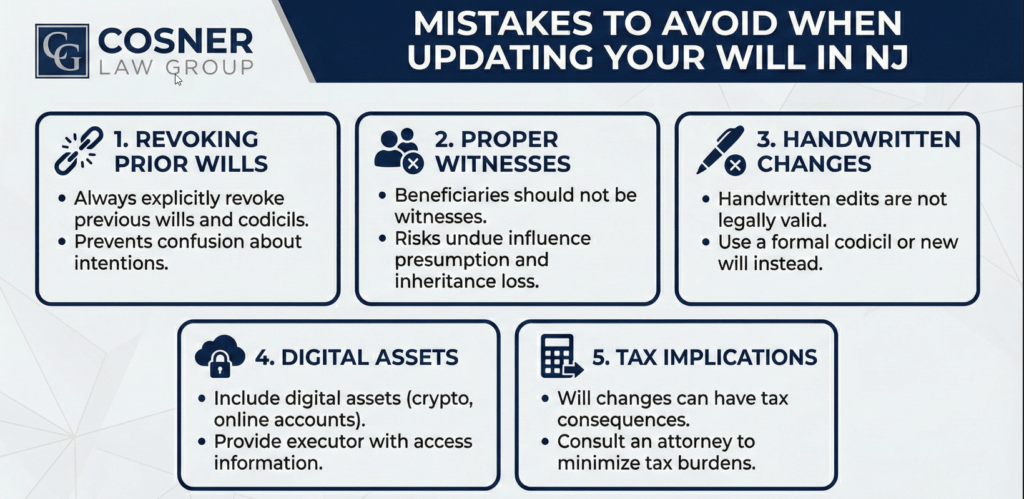
- Failing to Revoke Previous Wills
When creating a new will, always include explicit language revoking all prior wills and codicils. Without this language, questions may arise about which document represents your true intentions.
- Using Improper Witnesses
Beneficiaries should never serve as witnesses to your will. This creates a presumption of undue influence and may result in that beneficiary losing their inheritance. Choose disinterested witnesses who have no stake in your estate.
- Making Handwritten Changes
Never markup, cross out, or write changes directly on an existing will. These alterations are not legally effective in New Jersey and may create confusion about your intentions. If you need to make changes, execute a proper codicil or draft a new will.
- Neglecting Digital Assets
Modern estates often include digital assets such as cryptocurrency, online accounts, and digital media. Ensure your will addresses these assets and provides your executor with the information needed to access and distribute them.
- Forgetting About Tax Implications
Changes to your will may have unintended tax consequences for your estate or your beneficiaries. An estate planning attorney can help you structure your bequests to minimize tax burdens.
Special Will Update Considerations for New Jersey Residents
Spousal Rights
New Jersey law provides certain protections for surviving spouses. Even if your will leaves nothing to your spouse, they may have the right to elect against the will and claim a statutory share of your estate. Understanding these rights is crucial when planning your estate, particularly in second marriages or blended families.
Guardianship Provisions
If you have minor children, your will should name a guardian to care for them if both parents die. Regularly review this designation to ensure the named guardian remains appropriate and willing to serve.
Request a Free Consultation with Cosner Law Group to Update Your Will
With complex estate and probate law governing the will update process, turn to the highly experienced estate planning attorneys at Cosner Law Group for guidance.
Our attorneys guide, support, and advocate for New Jersey families seeking to protect their legacies and loved ones. Call upon 50 years of experience in New Jersey estate planning. Request a free, no-obligation consultation with Cosner Law Group by calling (732) 937-8000 or booking a consultation online.